
Blog
The Role of Connective Tissue Health in Strength Training
Resistance training is finally solidifying itself as the non-negotiable for longevity and quality of life. As a physical therapist assistant and strength coach, I have had the privilege of living through a shift in the health field over the last couple of decades that has pushed resistance training to the forefront of the health space.
Alongside this strength revolution, the amount of information and recommendations that we are exposed to can be overwhelming; moreover, with an influx and overload of new information and training concepts, the options and training methods available are rapidly multiplying. Therefore, having a clear understanding of the principles of “resistance training” can help filter through a lot of the seemingly misleading information that we might encounter on social media or other platforms.
Force Transduction: The Foundation of Adaptation

At its core, resistance training leverages the biological process of force transduction, a process that cells in our bodies undergo when they are exposed to mechanical forces. In simpler terms, it is a signal-response channel that initiates changes in bones, connective tissue, muscle tissue, and more.
The most important component of this process is in the name: FORCE. When cells experience sufficient force, they respond by adapting toward an improved ability to manage these forces. This is why resistance training works. Resistance training is how we organize and direct these changes, by applying resistance, or “load,” to specific tissues in the body where we want to see favorable adaptations.
It is important to note that muscle hypertrophy is not the only kind of adaptation we can achieve from resistance training. Depending on how we apply forces to the body, we can also stimulate other components that contribute to overall tissue health, such as the architecture and load-bearing capacity of connective tissue, neurological complexity, and even bone density.
Most of the information broadcast on social media critiques the efficiency of training methods from a strength and muscle-gain perspective exclusively, causing valuable forms of training that benefit other components to be overlooked. I am an unconditional advocate for strength and muscle development, but in my years of experience with clients dealing with injuries and pain, I have consistently noticed that the elements we neglect in training are the limitations and injuries we run into.
Most sports injuries occur at the connective tissue level (tendons, ligaments, etc.), yet I can count on one hand the number of people I have seen doing connective tissue work outside of physical therapy if they even do it in physical therapy at all. Similarly, almost every client I have worked with who was dealing with pain has coincidentally been severely neglecting rotational training for the joints affected. Fortunately, it is incredible what addressing those missing links can do for overall tissue health, performance, and longevity.
Load-Bearing Capacity: How Much Is Enough?
The health of a given tissue depends on how well it can manage the forces and accumulated stress of daily life. This is the same concept used in engineering to test the load-bearing capacity of materials or structures: if a structure’s load-bearing capacity is exceeded by external loads, its structural integrity will yield under the applied load.
There is no universal gold standard for how much load-bearing capacity each person needs, because the requirements to achieve adequate “tissue health” vary from person to person, as their life’s demands differ.
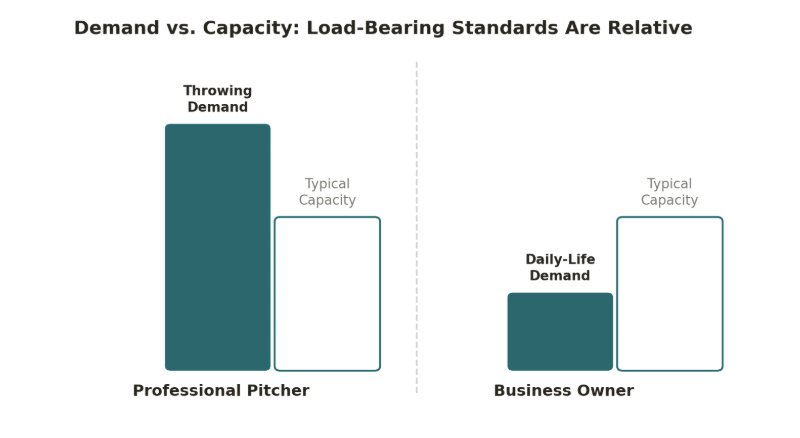
Consider: the forces a professional baseball pitcher’s shoulder experiences during each throw are much higher and faster than anything a business owner encounters day to day; therefore, load-bearing capacity standards for the shoulder should reflect those differences. This doesn’t mean the business owner has an unhealthy shoulder if it doesn’t measure up to the pitcher’s capacity but it should ideally exceed what his daily life demands.
I wish that preventing injury were as simple as increasing the capacity of a given tissue sufficiently to exceed general demands, as it may be for a structural stress test. Unfortunately, biological tissue is not always at full potential to manage stress. Variables like sleep, nutrition, inflammation, and emotional stress can significantly impact the percentage at which the body is operating, and can temporarily lower the threshold capacity of overall tissue.
It would be impossible to properly quantify these complex fluctuations in the body. But by approaching training through a tissue-health perspective, we can follow a thorough yet simple process to identify the most vulnerable and neglected tissues, and prepare a strategy to train the qualities of tissue health that may be falling short.
Why This Matters for Consistency
The potential of resistance training goes far beyond aesthetics and strength. When someone starts working out, there are generally specific goals in mind: more muscle, losing body fat, getting stronger, and so on. The most efficient way to reach your goals is consistency and hard work this isn’t news to anyone. But many fail to prepare for one of the biggest reasons people fall off consistency, outside of simply losing the habit: pain and injuries.
Therefore, identifying the vulnerable areas most likely to be the weak link in the chain, and cause potential issues, should be our first priority in training. This lets us dedicate proper effort toward developing higher-capacity, higher-quality tissue, which creates a sustainable training environment in the body, minimizes risk for inflammation or injury, and allows us to work on our actual training goals long term.
The Rehab Gap: Three Trainable Elements
My time in the clinical setting as a physical therapist assistant was short, I had a passion for programming and sports exercise that I couldn’t let go of. But during those years, I noticed that even though most injuries occur at the connective tissue level, almost all rehab programs focused heavily on building muscle tissue around a tendon or ligament, with barely any training aimed at rebuilding the architecture and load-bearing capacity of the tendon or ligament itself.
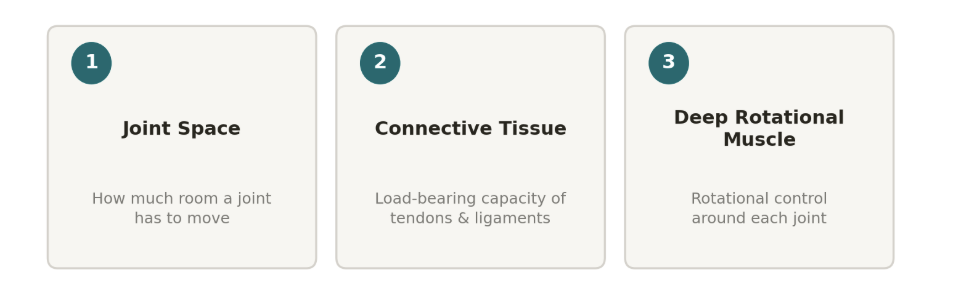
In fact, most approaches aim to protect the injury, when the best way to minimize future risk of reinjury is to prepare the tissue, not protect it. There are many elements that are “trainable” in the context of tissue health. For simplicity, let’s explore three that are often swept under the rug; joint space, connective tissue, and deep rotational muscle, and look at why each is so crucial for tissue health, and how to train to improve them.
Joint Space: The Foundation for Movement
If movement quality and performance could be represented as a building, joint space would be the amount of terrain available to lay the foundation. Joint space is extremely important because it dictates where we can move and where we can’t.
The first part of my process when working with someone is an evaluation that begins with a joint-by-joint assessment — identifying positions we need but don’t have access to is essential.
Case Example: Overhead Press and Low Back Pain
Let’s say someone has lower back pain. They’re given the typical recommendations for general low back pain: “strengthen the core, the glutes, and stretch the hamstrings.” Yet, when an evaluation is performed, we find that this individual lacks shoulder external rotation and flexion. As a result, he struggles to raise his arms overhead without compensating through the low and upper back and this individual also loves doing overhead presses.
What this tells us is that the low back pain may have more contributing factors than a weak core and glutes. Perhaps the lack of shoulder space, and the inability to perform an overhead press without leaning back and compensating with the low back, is a bigger culprit than the glutes and core. If that’s the case, using the typical recommendations alone won’t resolve the underlying issue causing the pain in the first place.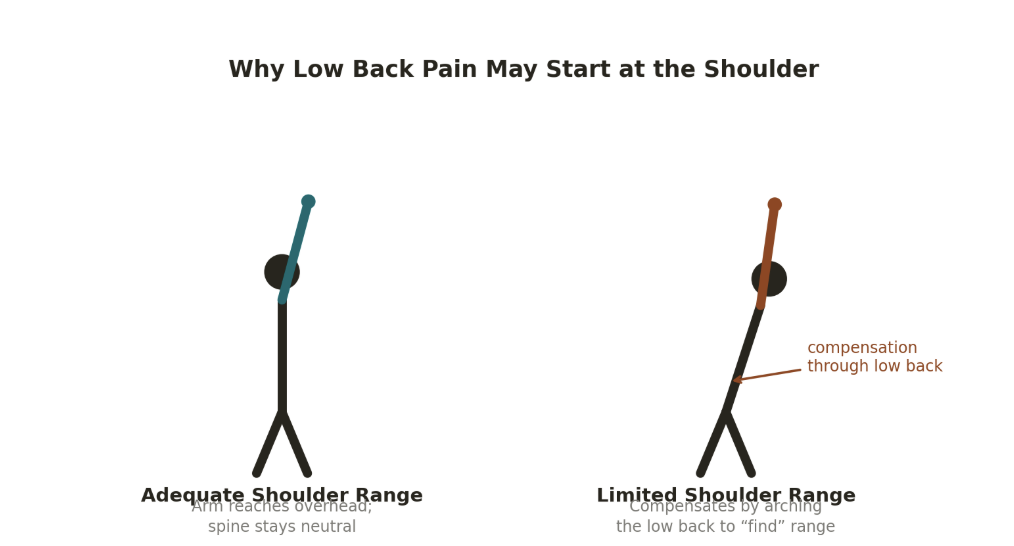
Mobility vs. Flexibility
Once specific ranges of movement are exposed and identified as insufficient, we can structure part of our training to expand these spaces this is typically considered “mobility” training. I want to emphasize that mobility and flexibility are not the same thing.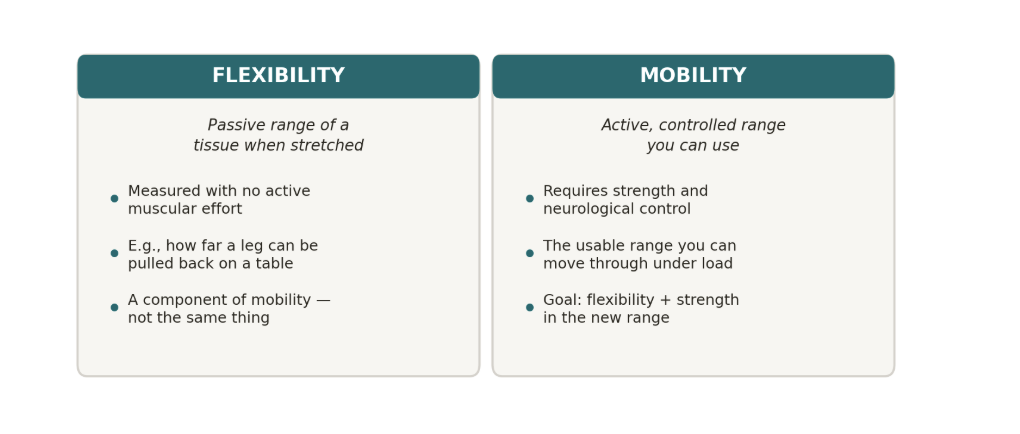
Flexibility is simply the capacity of a tissue to stretch passively. In other words, if I have someone on a therapy table, flexibility is how far I can pull their leg back toward their head. Mobility is the amount of real estate of joint space that we have strength and control over. Flexibility is a component of mobility, but flexibility without strength is simply more vulnerable space where we can make mistakes and cause potential injury.
To build and improve mobility, we need to gain flexibility, and as flexibility is attained, we need to follow it up with strength training of those new spaces.
The Mobility Training Sequence
Mobility training should be a sequence of exercises that serve different purposes, with each one opening the door for the next to be effective.
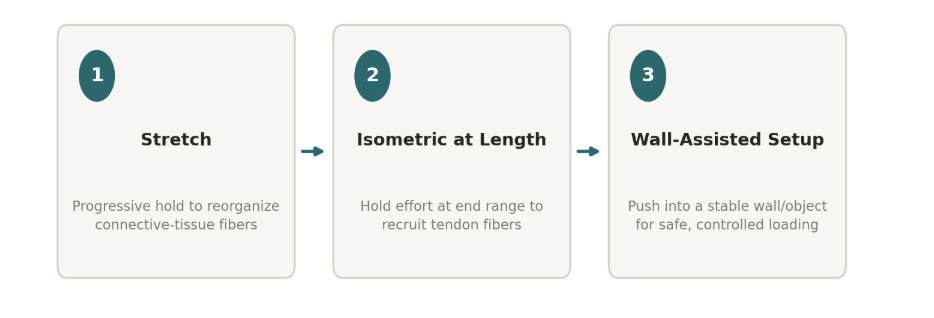
Step 1: Progressive Stretching
To expand the space available for movement in the joint capsule, purposeful and progressive stretching is a good start. This begins the process of reorganizing the fibers within the connective tissue to promote increased flexibility.
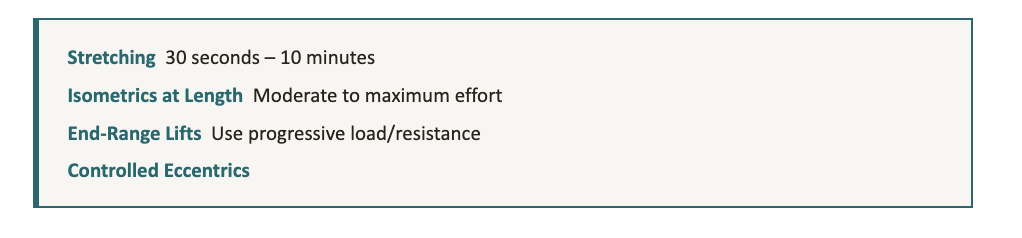
The duration of stretching is very important, and should be progressed. Initially, a 30–60 second stretch can be sufficient. As we become accustomed to that duration, however, further adaptation will require longer periods advanced stretching duration can reach up to 5–10 minutes within a single position. Proper stretches should not be comfortable, but they should not be painful either; the level of discomfort should be tolerable and should become easier to handle as the stretch is held.
Stretching on its own will temporarily increase the available passive range of motion of the target joint.
Step 2: Isometrics at Length
In order to reinforce the capacity and architecture of the tissue being stretched, the stretch should be followed with isometric contractions of the stretched muscle tissue. When a muscle is in a deep stretched position, it loses a significant amount of leverage to properly contract its fibers. By gradually increasing the level of effort in an isometric contraction at stretch, the nervous system has no option but to recruit the next available fibers: the tendons.
Step 3: Wall-Assisted Setup
An isometric contraction is also a very safe way to apply force to a potentially injured tissue. By using a stable wall or object to assist in maintaining the stretch and providing a surface to push against, we can contract the muscle and tendons without allowing the joint to move through any range of motion.
Using this technique also creates a training setup that allows for high-effort isometrics with little risk, while still being an effective option for healthy individuals and healthy tissue. Furthermore, by applying force in a position where the system has no choice but to distribute more mechanical tension through the tendons, the stimulus achieved can cause more specific and favorable changes to the tendons increasing load-bearing capacity and organizing the fibers to be better aligned to distribute and produce force. This, in turn, increases the force threshold for inflammation and injury.
Step 4: End-Range Strength and Eccentrics
After isometrics, end-range strength training develops the neurology needed to control the new spaces that are now available. Some examples of end-range training are end-range lifts and eccentric-biased movements. Once a new range is attained, it is typically vulnerable, as we have not yet developed strength within it.
End-range lifts are a great option to develop neurological control close to the end range. An eccentric contraction is the portion of the movement where the tissue is stretching under load while still resisting the load. In a bicep curl, the eccentric portion is represented by lowering the dumbbell from the flexed elbow position to the lengthened elbow position. Eccentrics can help increase the load-bearing capacity of tendons and ligaments that are particularly involved during the lengthened portion of eccentric movements.
A complete mobility sequence should increase the range of motion of a joint, develop the neurology to control that new space, and train the tissues around the joint to increase strength across all available ranges of motion — particularly the vulnerable ones. We have established recommendations for each of these components:
Rotational Training: The Overlooked Element
Rotational capacity of the tissues around a joint can be a direct indicator of the health and movement quality of that system. Except for the spine, all joints in the body depend on rotational capacities to operate in their linear movement function. This is why the rotator cuff is such a common pathway to recovery from shoulder injuries even so, we often miss out on the true potential of rotation.
The biggest key to all resistance training is to apply progressive overload long term. Progressive overload is the concept that as we get used to a certain intensity or variation of an exercise, the body needs an increased challenge to continue seeing results. Most people apply this to their favorite lifts and exercises, but when it comes to exercises that tend to be part of “physical therapy” or a “warm-up,” they don’t receive the same effort or attention. Furthermore, the only single-joint rotation exercise commonly seen is a variation of shoulder external rotation, leaving out every other joint.
Some examples of rotation training that should be included in most training programs:
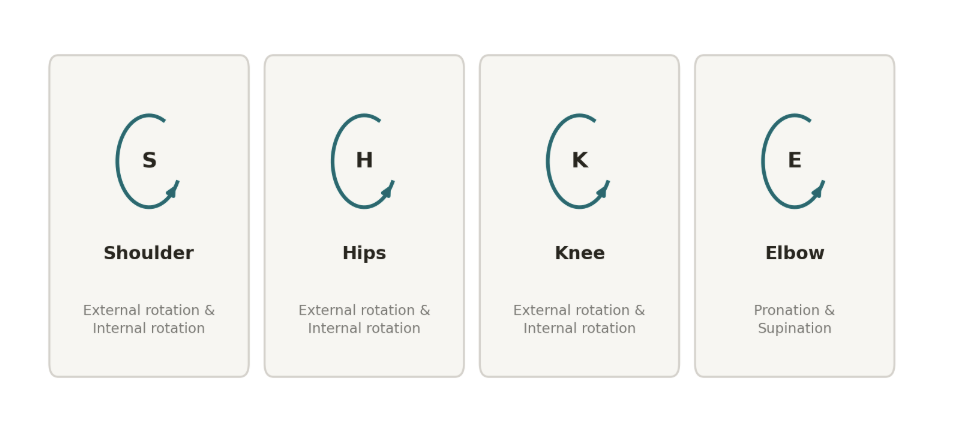
There is no valid reason to leave a key function of the body neglected in training, particularly in an area that presents recurring problems and could be contributing to injury, pain, and dysfunction. Keep in mind that there may also be range-of-motion limitations within these joints and positions. Applying the same mobility sequence outlined earlier to these joints would yield significant benefits that carry over into every aspect of training and daily life.
Putting It Into Action
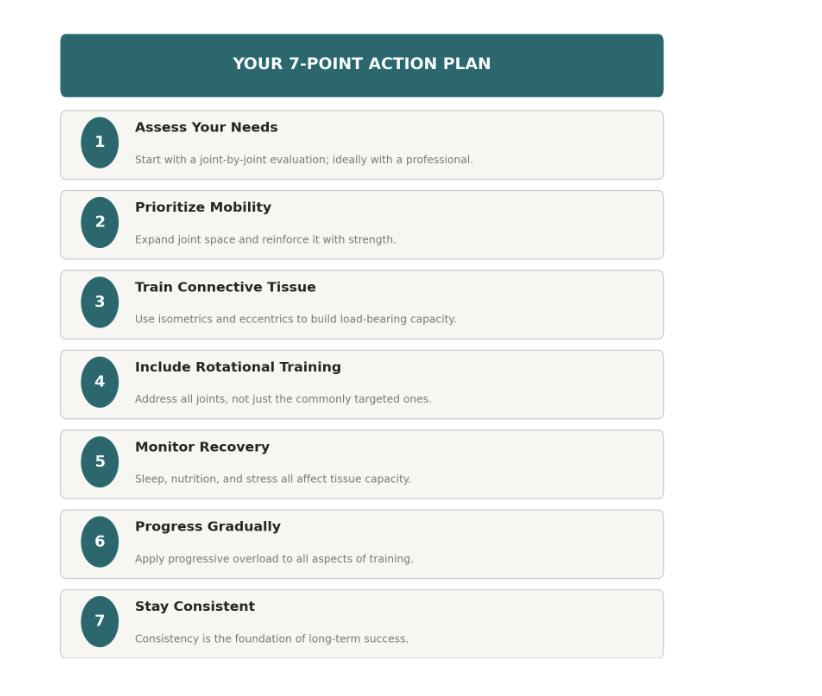
My biggest goal in communicating this information is to give readers the groundwork for a training strategy that invests in consistency by turning over the stones that are often left unnoticed. The most glamorous and popular exercises and training methodologies found on social media often have missing elements that, if left unchecked, can lead to problems and injuries down the line. To minimize risk and maximize long-term progress, performance, and quality of life, follow these strategies:
Conclusion
Optimizing tissue capacity isn’t just about preventing injuries it’s about unlocking your full potential. When your tissues can handle the demands of your life with a margin for safety, you’re less likely to experience setbacks. This resilience translates into sustained progress, improved performance, and a higher quality of life.
Resistance training is more than a tool for aesthetics or strength, it’s a comprehensive strategy for lifelong health. By understanding and applying the principles of force transduction, load-bearing capacity, mobility, and rotational training, you can minimize risk, optimize capacity, and set yourself up for long-term progress and performance. The journey isn’t always easy, but the rewards are profound.
Take the first step today. Assess your movement, identify your weak links, and incorporate the methods outlined in this article into your routine. Prioritize tissue health, train with intention, and commit to consistency. Your future self will thank you for the investment in resilience, performance, and quality of life.
About The Author
I’m Andres Corrales, also known as The Tissue Guy, a strength coach, content creator, physical therapist assistant, and founder of The Tissue Lab in Weston, Florida. Although I no longer work in a traditional clinic setting, my background in physical therapy continues to shape the way I think about training, movement, tissue adaptation, and long-term physical development. I also hold several certifications, including FRCms, FRSC, CES, PES, CNC, and CFSC Level 2.
My work focuses on bridging exercise science, biomechanics, connective tissue adaptation, and practical equipment applications so people can better understand how training can be structured with more intention. Through my content, I break down strength training concepts, gym equipment setups, and programming strategies in a way that is technically grounded, but still practical for coaches, lifters, and home gym owners. My goal is not just to show what exercises to perform, but to explain why specific tools, loading strategies, and movement setups can create better training outcomes. At The Tissue Lab, I work with clients in a private gym setting, using individualized strength training, mobility work, and progressive loading strategies to help improve performance, build resilience, and support long-term physical development.
Build Your Dream Home Gym with Ironmaster
Since 1978, Ironmaster has been trusted by serious lifters and home gym enthusiasts for delivering the best in heavy-duty, modular strength equipment built to last a lifetime. Whether you’re just getting started or upgrading your existing setup, Ironmaster.com has everything you need to train smarter at home—without compromising on quality. Start with the foundation: the legendary Super Bench Adjustable Weight Bench, known for its rock-solid stability and unmatched versatility. Then, level up your workouts with our Quick-Lock Adjustable Dumbbells, a fan-favorite for their rapid adjustability and space-saving, plate-sharing design. Need serious strength training capabilities? Add the all-in-one IM2000 Self-Spotting Machine, a hybrid Smith-style half rack that makes it easy to lift heavy safely, even when training alone. With dozens of compatible attachments, you can outfit a full-body gym in your garage, basement, or spare room.
Ready to save? Use our Custom Package Builder to bundle your favorite equipment and unlock automatic discounts—the more you bundle, the more you save