The Ultimate Guide to Weighted Vest and Ruck Training
How Weighted Vest and Ruck Training Improve Strength, Endurance, and Conditioning
By Taylor Jones •
January 16th, 2026
There’s a certain honesty to training that involves nothing more than your body, gravity, and a little extra weight. Weighted vests and rucks bring that honesty front and center. They strip away the noise and reveal the core of fitness — movement, resistance, and effort. When you train under load, your body learns efficiency, your mind learns patience, and your performance improves across the board. In this first half of our deep dive, we’ll focus on the weighted vest — one of the most versatile tools for athletes of every discipline. From functional fitness to obstacle course racing, the vest is a bridge between strength and conditioning, a simple way to turn familiar movements into full-body challenges that test not just muscle, but mindset.
Why Weighted Vest Training Works
At first glance, a weighted vest seems almost too simple to be effective. It’s just added weight, 3500 right? But the science behind why it works is far more compelling. By increasing your body mass, you’re forcing every muscle, tendon, and organ system to adapt to a higher demand. It’s progressive overload in its most primal form. Every step becomes a micro-resistance exercise. Every breath becomes more labored. Your cardiovascular system has to pump harder, your core has to stabilize better, and your muscles have to contract with greater precision. Over time, this translates to improved strength, stamina, and coordination. It’s the same principle that makes altitude training or sled pushes effective — you’re teaching your body to perform efficiently under increased stress. A weighted vest changes the “difficulty multiplier” of every workout you do. Air squats turn into weighted squats. A casual jog becomes a resistance run. Even holding a plank demands more from your core and shoulders. And because the vest distributes load across your torso rather than isolating it to one limb or axis, it challenges your entire kinetic chain — from your feet to your spine.
The Role of Load Distribution and Design
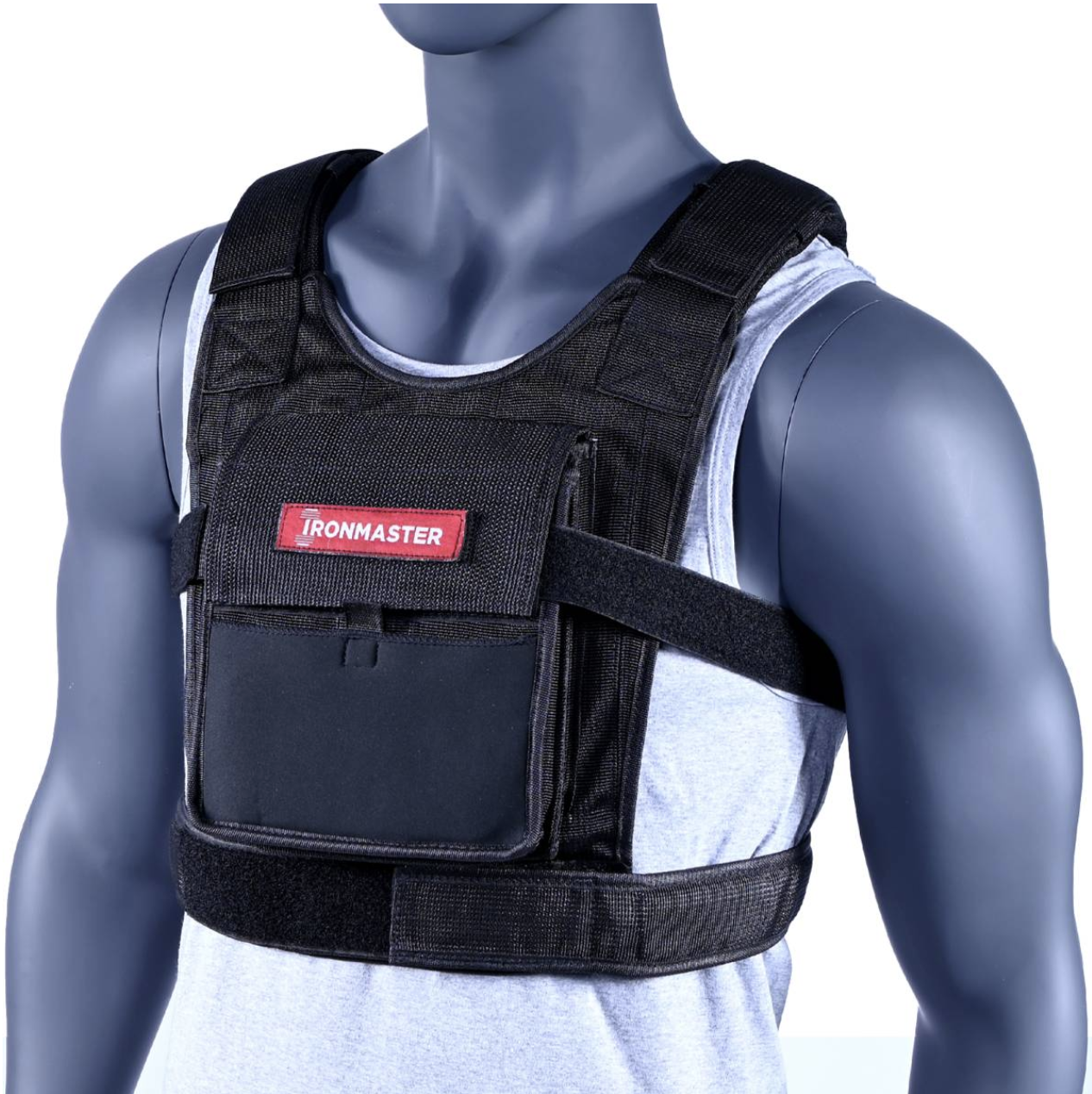
Not all vests are created equal. The balance, adjustability, and comfort of a vest make a massive difference in how your body handles the added load. A poorly designed vest shifts and bounces, disrupting your rhythm and placing uneven stress on your back and shoulders. A well-made one feels like part of your body — secure, balanced, and evenly loaded. That’s where something like the Ironmaster Ultimate Training Weighted Veststands out. It’s built for serious athletes who need both performance and comfort. The modular design allows you to increase or decrease weight easily, adjusting from light conditioning sessions to heavy-duty strength training without changing equipment. Its close fit keeps the load snug to your center of gravity, which prevents the jarring bounce that cheaper vests cause during running or jumping. Ironmaster’s materials are rugged — made for sweat, friction, and constant motion — but also surprisingly comfortable over long sessions.
The Benefits of Training Under Load
Adding weight doesn’t just make a workout harder — it changes how your body moves and adapts. Weighted vest training has benefits that reach far beyond the immediate burn.
1. Improved Strength and Power Output
A vest essentially increases your resistance on every rep. When you train with added weight and then remove it, your relative power output increases. You become faster, more explosive, and capable of sustaining higher intensities at your natural bodyweight. It’s the same principle sprinters use when they train with sleds or parachutes — overload to improve output.
2. Increased Cardiovascular Efficiency
Your heart and lungs have to work harder to circulate oxygen through a heavier, more demanding system. Over time, this strengthens your cardiovascular capacity. When you return to unloaded training, your body operates more efficiently, requiring less effort to achieve the same pace.
3. Enhanced Core Stability and Postural Strength
One of the biggest unnoticed benefits of weighted vests is how they train posture. The constant load on your torso forces your spinal erectors, obliques, and abdominal wall to maintain alignment. Even walking or jogging in a vest becomes an active posture drill that strengthens the muscles responsible for keeping you upright and injury-resistant.
4. Metabolic and Caloric Benefits
Extra resistance means more energy expenditure. You burn more calories during and after training, as your body works harder to recover and restore homeostasis. This makes vest training an excellent conditioning tool for athletes aiming to improve body composition while maintaining performance.
5. Bone Density and Joint Resilience
Like any form of resistance training, weight-bearing stress stimulates osteogenesis — the process that strengthens bones. A vest allows you to apply that same beneficial stress to the skeletal system without the heavy impact of loaded barbells. This can be particularly valuable for runners or endurance athletes who want bone-strengthening benefits without joint strain.
How to Use a Weighted Vest Safely
The first thing every athlete needs to know is that the vest magnifies everything — good form, bad form, and fatigue. If you already have movement inefficiencies, adding load will expose them quickly. The key is to start light and build gradually. Begin with 5–10% of your body weight. For a 180-pound athlete, that’s only 9 to 18 pounds. It doesn’t sound like much — until you’ve done a 400-meter run or a set of burpees. Focus on controlling every rep and maintaining posture through fatigue. Once you can move through workouts fluidly, increase by 2–5 pounds at a time. Proper fit is crucial. The vest should be snug enough to stay put but not so tight that it restricts breathing. Adjust the shoulder and chest straps so that the weight sits evenly across the torso and doesn’t shift side-to-side. During running or plyometrics, any bounce is a sign of poor fit — and it can lead to unnecessary stress on the lower back and knees. Recovery also plays a role. Because you’re increasing total mechanical load, your body will experience higher fatigue even if your workout duration remains the same. Prioritize mobility work for your hips, shoulders, and spine, and schedule lighter sessions between heavy vest workouts.
Choosing the Right Weight for Your Goals
The “right” vest weight depends entirely on what you’re trying to achieve. Think of it like percentage-based barbell training — each intensity range has its own benefit. For general fitness and conditioning, start with 5–10% of your body weight. This is ideal for walking, hiking, or basic calisthenics like squats, push-ups, and pull-ups. It builds endurance without compromising form. For functional strength and endurance training, 10–15% is a great sweet spot. At this range, movements like lunges, burpees, and step-ups begin to feel like serious strength work, and the cardiovascular system gets a strong hit as well. For Hero WODs or advanced CrossFit-style training, standard loads are 20 pounds for men and 14 pounds for women — the same weights prescribed for Murph and other benchmark workouts. These loads are challenging but sustainable for well-conditioned athletes. For running or longer aerobic efforts, go lighter — 5–8% of body weight is plenty. Too much weight can distort running mechanics and increase impact forces on the knees and ankles. Focus on posture and rhythm rather than speed.The guiding rule: choose a weight that challenges your breathing and muscular control, but not your form. If your movement quality deteriorates, reduce the load. The goal isn’t to crush yourself — it’s to build resilience sustainably.
Integrating Weighted Vests into Training
Weighted vests fit naturally into many training styles, especially those centered around functional or bodyweight movement. The versatility is what makes them so powerful — they can turn simple exercises into potent strength and conditioning tools.
Bodyweight Strength Work:
Classic calisthenics like push-ups, pull-ups, dips, and squats are all instantly more demanding under load. Even 10 pounds can dramatically change time under tension, improving both strength and endurance. For pull-up progressions, adding small increments of vest weight helps build strict pulling strength without the joint stress of using external machines or heavy belts.
Functional Fitness Circuits:
A vest adds a new dimension to metcon-style workouts. You can build circuits of short, intense rounds Or create AMRAPs (as many rounds as possible) with movements like step-ups, burpees, and lunges. These combinations elevate heart rate while building muscular endurance.
Short-Distance Running or Sprint Work:
Running in a vest demands control and efficiency. Keep distances short (100–400 meters) and focus on posture and stride rather than all-out speed. Hill sprints with a vest are an especially effective way to develop power without overstriding.
Hiking or Stair Workouts:
If you prefer endurance-style training, wear your vest on hikes, stair climbs, or incline treadmill walks. These sessions provide a hybrid between ruck training and weighted circuits — lower impact, but still incredibly effective for developing strength and stamina.
The Iconic Weighted Workouts: Murph and Chad
No discussion about weighted vests would be complete without mentioning Murph and CHAD 1000X. These are the benchmark workouts that define mental and physical toughness in the functional fitness community. Murph. Arguably the most famous Hero WOD, Murph honors Navy Lieutenant Michael Murphy and has become a Memorial Day tradition for athletes around the world. It’s simple on paper, brutal in execution:
•1-mile run
•100 pull-ups
•200 push-ups
•300 air squats
•1-mile run
(Wear a 20lb vest for men / 14lb for women)
The structure can be partitioned (for example, 20 rounds of 5 pull-ups, 10 push-ups, and 15 squats) to make it manageable, but even then, the combination of endurance and volume is punishing. The vest adds a layer of realism — a nod to the load military operators carry — and transforms the workout from bodyweight conditioning to full-body resistance training.
CHAD 1000X
CHAD 1000X is another Hero workout, created in honor of Navy SEAL Chad Wilkinson. It’s deceptively simple:
•1,000 step-ups for time (20′ box, with a 45lb ruck for men / 35lb for women)
That’s it. No fancy programming, no complex movement — just steady, consistent effort. It’s a grind that builds not only leg endurance and aerobic capacity but also mental fortitude. Most athletes underestimate it until they’re a few hundred reps in, when fatigue starts whispering that quitting sounds nice. That’s when CHAD truly begins. Both workouts embody what load training represents — perseverance, simplicity, and purpose. They’re more than just physical tests; they’re reminders of discipline, commitment, and the deeper meaning behind effort
From Function to Mindset
Weighted vests do more than build strength or burn calories — they build perspective. When you add external resistance to movement, you feel every rep differently. You slow down, focus more, breathe deeper. The load forces mindfulness, because moving under resistance demands intention. There’s also a mental shift that happens when you train with added weight. It’s humbling. It makes simple things hard again. But when you take that vest off, the world feels lighter — both physically and mentally. That’s one of the most powerful carryovers of this type of training: you build the strength to handle discomfort, and that translates to everything from endurance events to everyday challenges. Weighted vests, particularly well-built models like the Ironmaster Ultimate Training Vest, offer the perfect blend of challenge and adaptability. They fit neatly into any training style, whether your focus is functional fitness, obstacle course racing, or hybrid strength and endurance training. They remind us that progress doesn’t always require more complexity — sometimes it’s as simple as adding resistance and moving with purpose.
Rucking, Hybrid Conditioning, and Loaded Endurance
Weighted vest training isn’t the only way to challenge your body under load. For decades—long before functional fitness became mainstream—rucking was the go-to conditioning method for soldiers, explorers, and endurance athletes who needed practical, real-world stamina. What began as a military requirement has evolved into one of the most accessible and effective forms of loaded endurance training available to anyone willing to put one foot in front of the other… again and again. If a weighted vest teaches you control under intensity, rucking teaches you patience under fatigue. It’s slow, steady, and deceptively hard. It develops a different kind of toughness—one that isn’t measured in reps or rounds but in how long you can keep moving when everything feels heavy.
What Exactly Is Rucking?
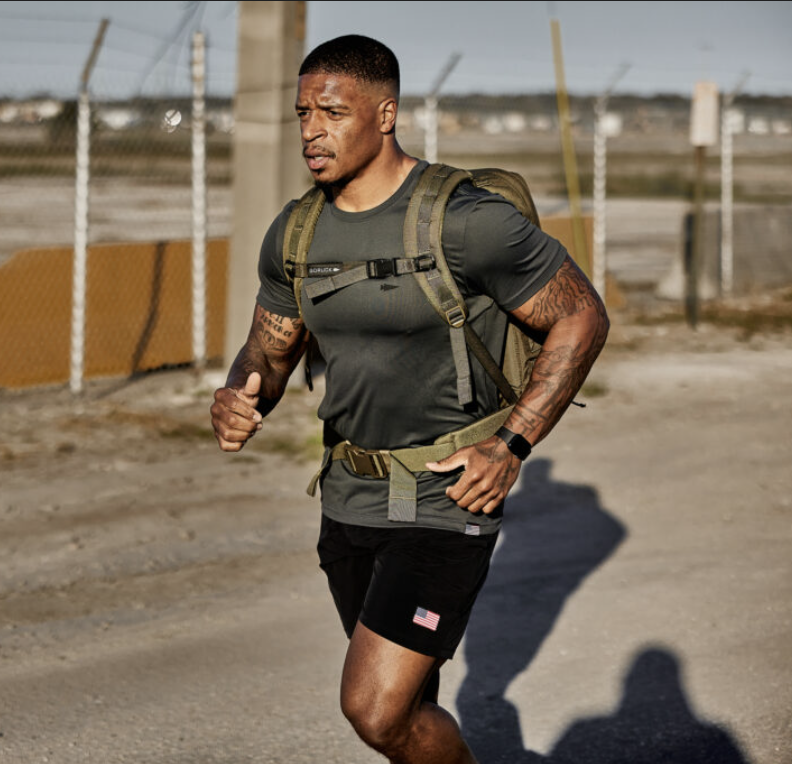
In the simplest terms, rucking means walking or hiking with a weighted pack. The term comes from the military “rucksack”, a gear-laden backpack used to carry essential supplies during long-distance missions or marches. Over time, the practice evolved beyond the military and found its place in fitness communities, endurance sports, and even recovery-based conditioning programs. At its core, rucking is a form of low-intensity, steady-state cardio that’s enhanced by external load. It combines the aerobic benefits of walking or hiking with the muscular and skeletal stress of resistance training. You’re not moving explosively like you would in a HIIT workout, but you’re engaging your entire posterior chain—glutes, hamstrings, calves, core, and even upper back—for extended periods. Rucking bridges the gap between cardio and strength work. It’s simple, scalable, and doesn’t require a gym or special equipment. A sturdy backpack, a few sandbags, plates, or bricks for load, and a good pair of shoes are all you need. That accessibility is part of its charm—and also why it’s become a foundational training method for athletes who want to build real-world conditioning without the wear and tear of constant high-impact exercise.
Why Rucking Works: The Physiology of Load and Endurance
Rucking is a form of zone two training under resistance. That means you’re primarily operating in an aerobic heart rate zone—roughly 60–70% of your max heart rate—where fat is the primary fuel source. But the added weight amplifies every physiological demand. Your body must produce more force per step, stabilize more dynamically, and manage breathing under sustained tension. This combination of low-intensity endurance and mechanical load creates a powerful adaptive signal. It improves:
•Aerobic efficiency (your body’s ability to deliver and use oxygen)
•Muscular endurance and stability, especially in the hips and legs
•Postural strength and core control
•Metabolic flexbility, or the ability to efficiently shift between fat and carbohydrate fuel sources
•Mental resilience, through long, sustained effort
Unlike running, which can become high-impact and stressful on joints over time, rucking delivers similar cardiovascular benefits at a much lower impact cost. It’s a sustainable, repeatable training method that supports recovery instead of compromising it. For athletes who already push intensity through lifting or interval work, rucking can be the perfect complement.
The Benefits of Rucking for Functional Athletes
For functional fitness athletes, obstacle course racers, and anyone who blends strength with endurance, rucking fits naturally into a balanced training program. The benefits go far beyond general conditioning.
1. Enhanced Work Capacity Without CNS Burnout
One of the challenges of traditional high-intensity training is central nervous system fatigue. Too many max-effort days can lead to burnout. Rucking offers a way to build capacity—both physical and mental—without spiking cortisol or depleting your nervous system. It’s demanding, but it’s steady. You can recover from it faster while still reaping significant aerobic and muscular benefits.
2. Improved Core and Postural Strength
Walking under load forces your trunk to stabilize dynamically with every step. The constant micro-adjustments strengthen your spinal erectors, deep core, and upper back. It’s like performing a thousand controlled anti-rotation exercises every session. Over time, this builds better posture, balance, and even running economy.
3. Grip and Shoulder Durability
If you’re using a traditional ruck or heavy-duty backpack, your traps, lats, and shoulders are always working to stabilize the load. These smaller stabilizers often go undertrained in barbell or machine-based movements, yet they play a huge role in long-term shoulder health and injury prevention.
4. Mental Endurance and Discipline
Rucking doesn’t have the fast, flashy appeal of a metcon. It’s repetitive, quiet, and internal. But that’s exactly why it’s powerful. The slow grind of distance under load develops mental grit. It’s a form of moving meditation where discomfort becomes your companion instead of your obstacle. That kind of mental fortitude transfers directly into long events, races, and even life outside training.
5. Recovery and Active Conditioning
For athletes dealing with joint stress, overtraining, or fatigue, rucking is a way to keep moving while healing. The low-impact nature allows for active recovery days that still build the aerobic base. It’s perfect for “deload weeks” or between heavy barbell cycles.
How Much Weight Should You Ruck With?
There’s no universal formula, but most athletes benefit from starting lighter than they think. The load should challenge your breathing and posture—but not your stride mechanics. Too heavy, and your gait will change, which can lead to hip and knee strain.
Here’s a general guide based on bodyweight and training goal:
•Beginner (conditioning, general fitness): 5-10% of body weight
•Intermediate (functional training, OCR prep): 10-20% of body weight
•Advanced (military prep, CHAD-style endurance): 20-30% of body weight
For example, a 180-pound athlete might start with 15–20 pounds for brisk walks, 25–30 for hikes, and 35–45 pounds for extended endurance events. Keep in mind that terrain, distance, and pace matter as much as weight. A 20-pound pack on steep hills may feel like 40 on flat ground. If you’re new to rucking, begin with shorter distances—1 to 2 miles—and increase weekly volume gradually.
Technique and Mechanics: The Art of Moving Under Load
Like any form of resistance training, rucking has technique. It’s not just “put on a pack and walk.” How you carry and move with the weight determines both the effectiveness and the longevity of your progress.
•Keep the pack high and tight: the weight should sit snugly against your upper back, not sag around your hips. Loose packs bounce and pull on the shoulders leading to fatigue or strain.
•Engage your core: Maintain a slight brace through your midsection, similar to how you would during loaded carries or front squats. This helps protect your spine.
•Shorten your stride: Keep steps controlled and deliberate. Overstriding amplifies impact forces.
•Stay Upright: Resist the urge to lean forward excessively. Imagine stacking your rib cage over your pelvis.
•Wear proper shoes: Supportive, cushioned footwear is essential preferably trail or hiking with stable midsoles.
Rucking rewards patience and attention to form. As fatigue sets in, your posture will naturally want to collapse. Fight that. The more you maintain structure through exhaustion, the stronger your postural endurance becomes.
Weighted Vest vs. Ruck: Which Is Better?
This question gets asked a lot, and the real answer is—it depends on your goal. Both tools have overlapping benefits but serve different purposes.
Weighted vests excel in dynamic, multi-directional training. They’re ideal for functional fitness workouts, short runs, calisthenics, and conditioning circuits. Because the load is distributed evenly across your torso, you can move explosively without worrying about imbalance or shifting weight.
Rucksacks or backpacks, on the other hand, are built for endurance and load management. They focus on sustained effort, long durations, and grip/postural development. The weight sits posteriorly, engaging the back chain and stabilizers more than the front.
Here’s a quick comparison:
Training Goal: Short-duration conditioning (MetCons, HIIT) Best Tool: Weighted Vest Why: Balanced load with unrestricted movement
Training Goal: Long endurance or hiking sessions Best Tool: Ruck Why: Load sits comfortably for longer distances
Training Goal: Strength–endurance combination Best Tool: Either Why: Depends on movement selection
Training Goal: Obstacle course race preparation Best Tool: Weighted Vest Why: Mimics varied load-bearing demands
Training Goal: Joint-friendly conditioning Best Tool: Ruck Why: Lower impact than dynamic weighted vest workouts
Why These Methods Belong Together
Weighted vests and rucks aren’t new ideas. They’re old-school principles reborn for modern athletes who understand that fitness isn’t just about appearance — it’s about function, resilience, and readiness. They both build real strength — not just in the gym, but in life. Carrying load is a fundamental human skill. It’s what we evolved to do. Whether it’s a barbell, a pack, or a vest, moving under resistance connects us to that primal element of training that machines and mirrors can’t replicate. Ironmaster’s weighted vest represents the high-performance side of that equation: balanced, adjustable, and built for precision. Rucking represents the raw, grounded side: simple, gritty, and accessible. Together, they create a full spectrum of load-bearing capability—explosive, sustainable, and unshakable.
Mental Training: Learning to Embrace the Load
There’s a psychological shift that happens when you train under load for long durations. You stop fighting the discomfort and start working with it. The rhythm of rucking or vest conditioning becomes a form of moving mindfulness — each breath, each step, each repetition a small act of discipline. Many athletes find that these sessions do more for mental health than physical performance alone. There’s something meditative about loading up a pack or strapping on a vest and moving forward—no screens, no distractions, just effort and silence. You begin to build a different kind of resilience: not the explosive “go hard” mentality, but the steady, grounded strength of showing up and doing the work, mile after mile.
Closing Thoughts: Building the Complete Athlete
Weighted vest and ruck training aren’t just about adding weight — they’re about adding intention. They teach control, consistency, and the kind of quiet toughness that carries over into every area of performance. When you strap on a vest or shoulder a ruck, you’re choosing resistance. You’re telling your body, “I can handle this.“ Over time, that message becomes truth. Your legs get stronger, your lungs expand, your mind hardens, and everyday movement feels easier. Whether you’re training for your next Spartan, prepping for Murph, or simply trying to stay fit for life, remember this: progress doesn’t always require new tools — sometimes it’s about rediscovering the power of the simplest ones, used with purpose. So, grab your Ironmaster Ultimate Training vest, load up your ruck, and start walking. The weight won’t get lighter, but you will get stronger.
About the Author
Taylor Jones is a versatile fitness enthusiast being a jack of all trades. Having initially excelled as a D-2 soccer player during her collegiate years, she transitioned her passion for sports into functional fitness, obstacle course racing, and a deep affection for outdoor adventures. Despite her demanding profession as a nurse, where she tirelessly works 12-hour shifts, Taylor manages to dedicate herself to rigorous training for competitions while finding solace in the company of her husband and two beloved dogs. With a keen focus on her athletic pursuits, Taylor’s primary objective has revolved around participating in the RF Challenges over the past two years. In both 2023 and 2022, her dedication bore fruit as she clinched the 2nd place title for the overall scoring.
Build Your Dream Home Gym with Ironmaster
Since 1978, Ironmaster has been trusted by serious lifters and home gym enthusiasts for delivering the best in heavy-duty, modular strength equipment built to last a lifetime.
Whether you’re just getting started or upgrading your existing setup, Ironmaster.com has everything you need to train smarter at home—without compromising on quality.
Start with the foundation: the legendary Super Bench Adjustable Weight Bench, known for its rock-solid stability and unmatched versatility. Then, level up your workouts with our Quick-Lock Adjustable Dumbbells, a fan-favorite for their rapid adjustability and space-saving, plate-sharing design.
Need serious strength training capabilities? Add the all-in-one IM2000 Self-Spotting Machine, a hybrid Smith-style half rack that makes it easy to lift heavy safely, even when training alone. With dozens of compatible attachments, you can outfit a full-body gym in your garage, basement, or spare room.
Ready to save? Use our Custom Package Builder to bundle your favorite equipment and unlock automatic discounts—the more you bundle, the more you save.